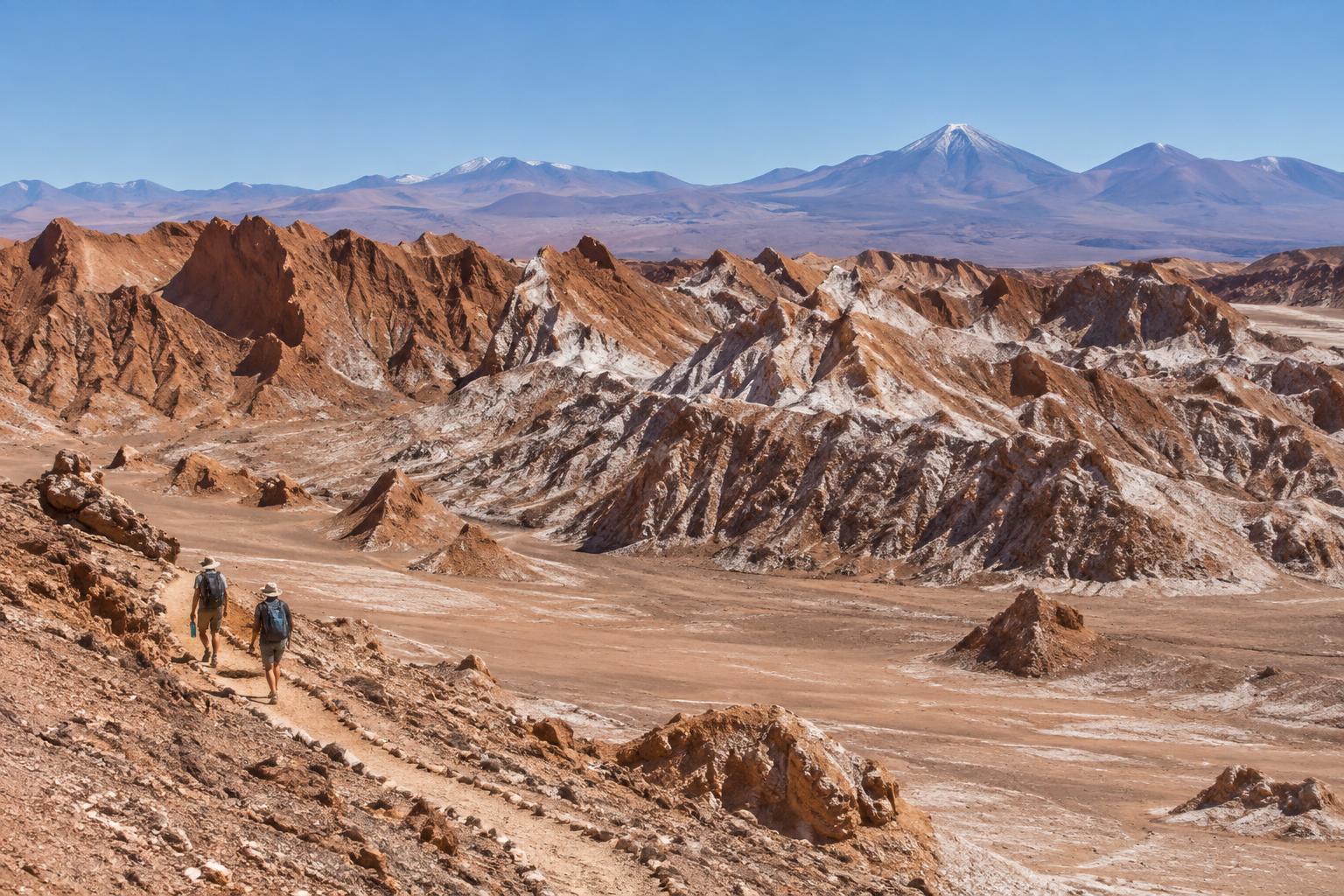
A landscape best explored at walking pace
Near San Pedro de Atacama, Valle de la Luna is a landscape of ridges, dunes, salt formations and pale rock shaped by wind and erosion. Its name evokes the Moon, but the appeal is in the details: changing colors across a slope, a crust of salt beside a path and the scale of the desert beyond the nearest viewpoint. Walking gives you time to notice these features without treating the valley as a single photo stop.
The valley is an organized visitor area, not an open invitation to wander wherever the ground looks passable. Access points, permitted activities and individual trails can change, so check the rules and route information available when you arrive. A map from an entrance or visitor point, along with posted signs, is more useful than an old description of a trail.
How to approach the marked routes
Choose a designated walking route that suits the time you have, then follow its markers from start to finish. Some paths lead to viewpoints; others bring you closer to rock and salt formations. A viewpoint reached by a short walk can be as rewarding as a longer outing, particularly if you pause to look back at the changing shapes of the valley. Do not assume that a visible track across the sand is an approved route: it may be a vehicle track, an old path or a shortcut made by previous visitors.
Read signs at junctions and respect barriers even when a closed area appears easy to cross. Sandy or crusted surfaces can be fragile, and a shortcut can leave a mark long after you have gone. If you are visiting with a guide, confirm which sections involve walking rather than driving between stops. If you are exploring independently, identify your return route before setting off and allow time to get back without rushing.
Plan for sun, wind and little shade
Desert walking can feel easy while the air is cool, then become tiring as the sun grows stronger. Shade may be scarce on exposed paths, and wind can lift dust or make a viewpoint feel colder than expected. Carry enough drinking water for your visit, wear a hat and sun protection, and bring a layer you can put on when conditions change. Closed shoes with a secure grip are more practical than sandals on loose sand, gravel and uneven rock.
The San Pedro de Atacama area is at high elevation, which some visitors find makes exertion harder. Take an unhurried pace, especially if you have only recently arrived in the region. Turn back if the walk feels beyond your comfort level; completing a route is less important than enjoying it safely. Check the permitted visiting hours and your transport arrangements before entering, rather than relying on a sunset plan that leaves too little time for the walk back.
Navigate without relying on your phone alone
Phone maps can help with the wider journey, but they should not replace signs and current information inside the visitor area. Signal and battery life may be unreliable, and a line on a screen may not show whether a route is currently open. Keep track of the last marked junction you passed, and stop to check your direction if a path becomes unclear rather than continuing across unmarked ground.
Tell a travel companion which route you intend to take, or agree on a clear meeting point if you separate. If you arrive by bicycle or vehicle, leave it only where permitted and make sure you know how to find it again. These simple habits make a relaxed visit easier, particularly when several viewpoints and paths look similar from a distance.
Leave the valley as you found it
Valle de la Luna’s formations are part of the experience, not souvenirs. Leave rocks and salt in place, avoid climbing formations unless a route explicitly permits it, and carry out everything you bring in. Staying on designated paths also protects the landscape for the next visitor. For photographs, look for a different angle from an approved viewpoint rather than stepping beyond a barrier.
A thoughtful visit can be simple: choose a manageable walk, give yourself time to observe, and follow the guidance of the people looking after access to the area. The desert’s quiet and space are easier to appreciate when you are not hurrying from one landmark to another.


