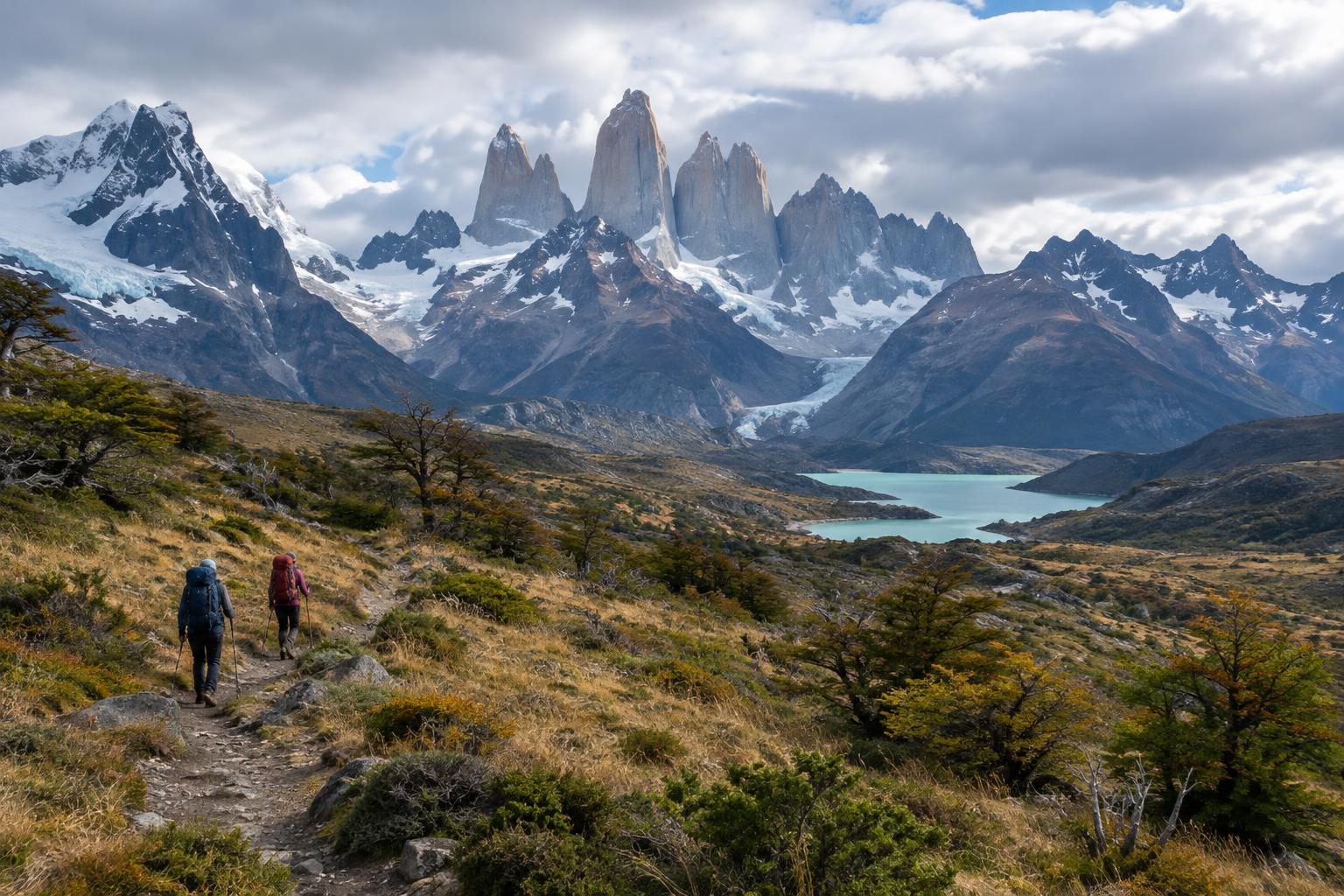
The routes at a glance
The W is the shorter trek through Torres del Paine’s best-known valleys. Its branches lead toward the towers, the French Valley and Grey Glacier. Many walkers allow four or five days, although the exact route depends on where they start, finish and sleep. The O adds a circuit around the back of the Paine massif before joining the W’s trails. It commonly takes seven to ten days.
Treat published distances as estimates rather than promises. A W itinerary is often described as roughly 70–80 kilometres, while an O itinerary may be around 110–130 kilometres. Figures change according to transport connections, campsite locations and whether a guidebook counts optional walks to viewpoints. Compare day-by-day distances for the itinerary you would actually follow, not just the headline total.
How the terrain differs
Neither route is a continuous technical climb, but both involve repeated ascents and descents on uneven ground. Expect rocky paths, roots, muddy stretches and exposed sections where wind can make a straightforward walk feel harder. The branches of the W can be especially demanding on days when you climb to a viewpoint and return by the same path. A short-looking day on a map may still require several hours of steady walking.
The O includes those familiar challenges and adds a more sustained stretch on the park’s quieter northern side. Its crossing of John Gardner Pass is a significant difference: the approach climbs into exposed terrain, and the descent toward Grey can be long and steep. Conditions can change quickly, so allow time in your daily plan rather than assuming you will maintain the same pace throughout. A route’s difficulty is shaped as much by weather and pack weight as by its distance.
Time on the trail and daily commitment
The W suits travelers who want several full trekking days without making the walk the centrepiece of an entire trip. Some itineraries use accommodation that allows a lighter pack; others involve carrying camping equipment. There is room to choose longer or shorter days, but the route still calls for consecutive walking days and careful attention to transport at its ends.
The O asks for a longer run of days, more food and clothing planning, and comfort with walking while tired. On its northern section, accommodation choices and opportunities to change plans can be more limited than on the W. That does not mean every day is harder, but it does make the overall commitment greater. If you have little experience with multi-day walks, a shorter trek with a loaded pack can be a useful way to learn what pace feels sustainable.
Leave space around either trek in your wider travel schedule. Getting to and from trail access points takes time, and weather may affect what you can see even when the path remains walkable. An extra day in your itinerary is more useful as breathing room than as a reason to rush between camps.
Bookings and preparation
Both routes require more preparation than simply turning up at a trailhead. Overnight stays, park access and transport connections may need to be arranged separately. Campsites and refugios differ in what they provide, so check whether your booking includes a bed, tent, meals or only a place to pitch. Confirm current trail rules, route directions, opening arrangements and reservation requirements with the relevant official sources and accommodation providers before committing to flights or onward travel.
Build your packing list around layers, rain protection, sturdy footwear you have already worn and a way to keep essential items dry. Carry the supplies your particular overnight arrangements require, and avoid assuming that food or equipment can be bought along the trail. Before each walking day, check the route, expected conditions and any guidance from park staff. If a section is closed or conditions exceed your experience, change the plan rather than trying to keep to a schedule.
Which trek should you choose?
Choose the W if your time is limited or you want a demanding but shorter introduction to multi-day walking in Patagonia. It offers a strong sense of the park’s varied landscapes without requiring a full circuit. Choose the O if you have more days, are comfortable with consecutive long walks and want to experience the northern side as well as the W’s valleys.
Neither choice needs to be treated as the complete or superior way to see Torres del Paine. A sensible itinerary matches your walking experience, available bookings and willingness to adapt to conditions. Whichever route you take, stay on designated trails, follow local rules and give yourself enough time to enjoy the landscape without turning every day into a race.


