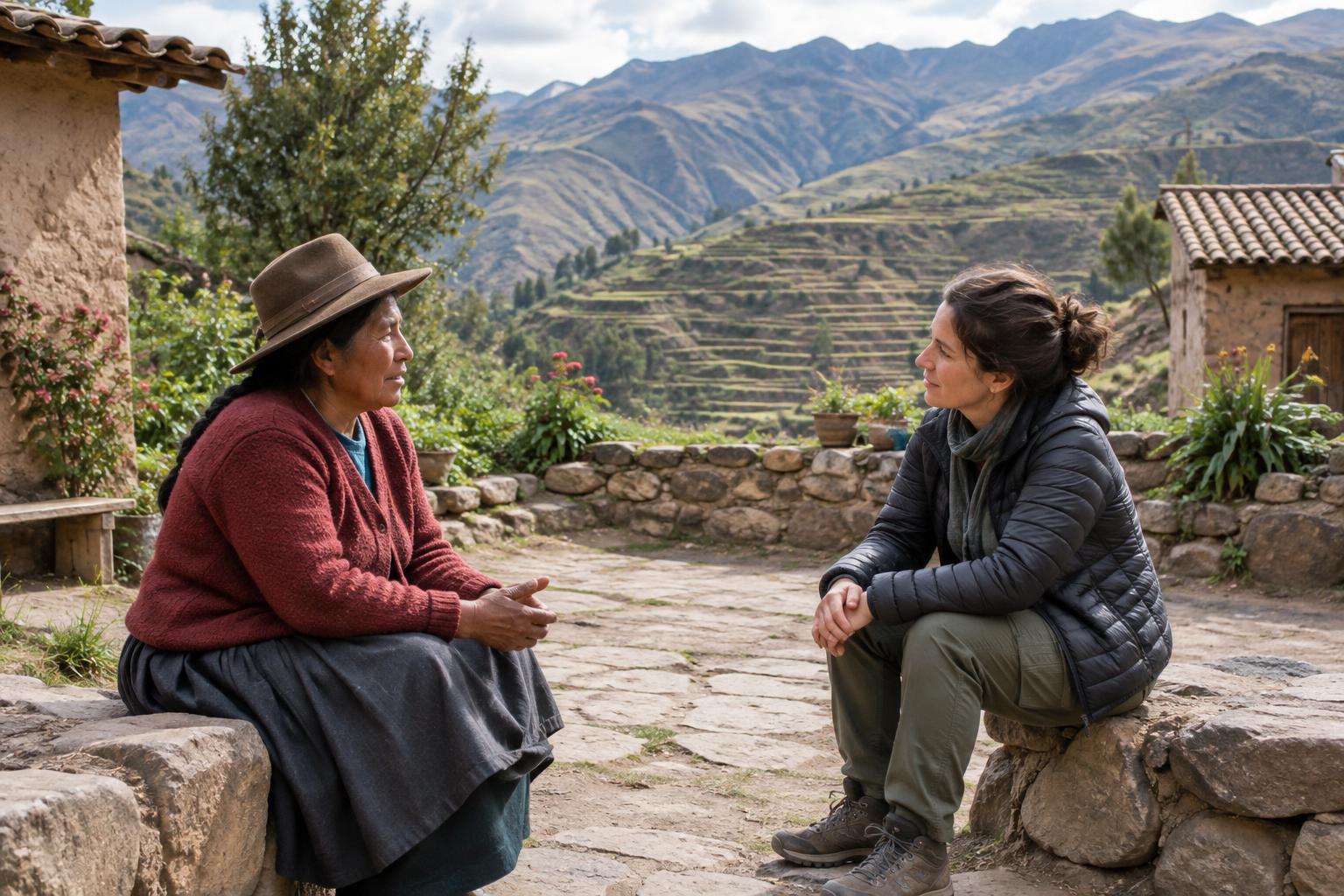
Start with the person, not the picture in your head
The Andes stretch across several countries and include cities, farming areas, small towns and remote valleys. People who live there do not share a single identity or way of life. Even within one region, neighbours may have different languages, livelihoods, beliefs and relationships with tradition. Describing someone simply as “an Andean villager” can flatten all that variety. When you know a more precise place name or the term someone uses for their own community, use it. When you do not, a broader description is better than a confident guess.
Travel images can make daily life seem timeless or untouched by modern life. Resist the urge to describe people as if they exist to preserve a past for visitors. A person may take part in a longstanding festival, use a smartphone, work in tourism and have relatives in a city. None of those details makes another less authentic. Notice what is actually in front of you rather than measuring it against an imagined version of the Andes.
Make questions an invitation, not a demand
Asking is often better than assuming, but a question still places a demand on someone’s time. Start with an ordinary greeting and pay attention to whether the person seems interested in talking. If they are busy, give a short answer or turn back to their work, let the conversation end. A guide, host or craft seller is not obliged to explain a whole culture to every visitor. If a language barrier makes a conversation difficult, accept that some things may remain unclear rather than pressing for an answer.
Try questions that leave room for a person’s own account: “What would you like visitors to know about this place?” or “Is it all right to ask about this?” These are more open than “Why do your people always do this?” Avoid treating one answer as a rule for everyone. If a topic is personal, sacred or politically sensitive, someone may prefer not to discuss it. A respectful response is to thank them and move on, not to ask the same question in another way.
Treat photographs and stories as shared decisions
A public street or market is not automatically an invitation to photograph the people in it. Before taking a close-up portrait, ask permission in a way the person can understand, and be ready to put the camera away if the answer is no. Take particular care with children: their presence in a public place does not remove the need for appropriate adult permission. If a sign or your host asks visitors not to photograph a ceremony or space, follow that guidance even when others have their cameras out.
Consent to a photograph does not necessarily mean consent to every use of it. Posting an image with a caption that guesses someone’s name, beliefs, income or feelings can create a story they never chose to tell. The same caution applies to conversations. Before sharing a personal account, consider whether the person knew you might publish it and whether identifying details are necessary. You can describe what you learned from an encounter without turning someone into a symbol of an entire community.
Notice the language you use afterward
Travel writing often relies on shortcuts. Words such as “primitive,” “untouched” or “stuck in time” suggest that a community is behind the traveller on a single path of progress. Phrases such as “the locals believe” can give one conversation more authority than it deserves. Replace sweeping claims with observations you can stand behind: “At the market I visited, several vendors sold woven goods,” for example, says what you saw without implying that every household makes them.
Attribution helps, too. If someone tells you about their own work or experience, make clear that it is their account, not a universal explanation. If you are unsure how to name a practice or place, ask when appropriate, check the spelling if possible, or use a modest description instead. Being specific does not mean collecting every personal detail. Often the most respectful choice is to name a place accurately while leaving a private person unnamed.
Leave room to be corrected
You will not understand every interaction during a trip, and you do not need to pretend otherwise. A good travel account can say, “I did not know the reason,” rather than fill a gap with a guess. If someone corrects your pronunciation, description or assumption, listen without asking them to reassure you. Thank them, adjust your language and remember that their view may still be one perspective among many.
Respectful travel is less about finding perfect words than about practising attention. Give people space to decline a conversation, photo or question. Pay for goods or services without assuming a purchase entitles you to someone’s personal story. When you tell others about your journey, distinguish what you witnessed from what you inferred. These small habits help keep the people you meet at the centre of their own lives, rather than in a role your travel story has assigned to them.


