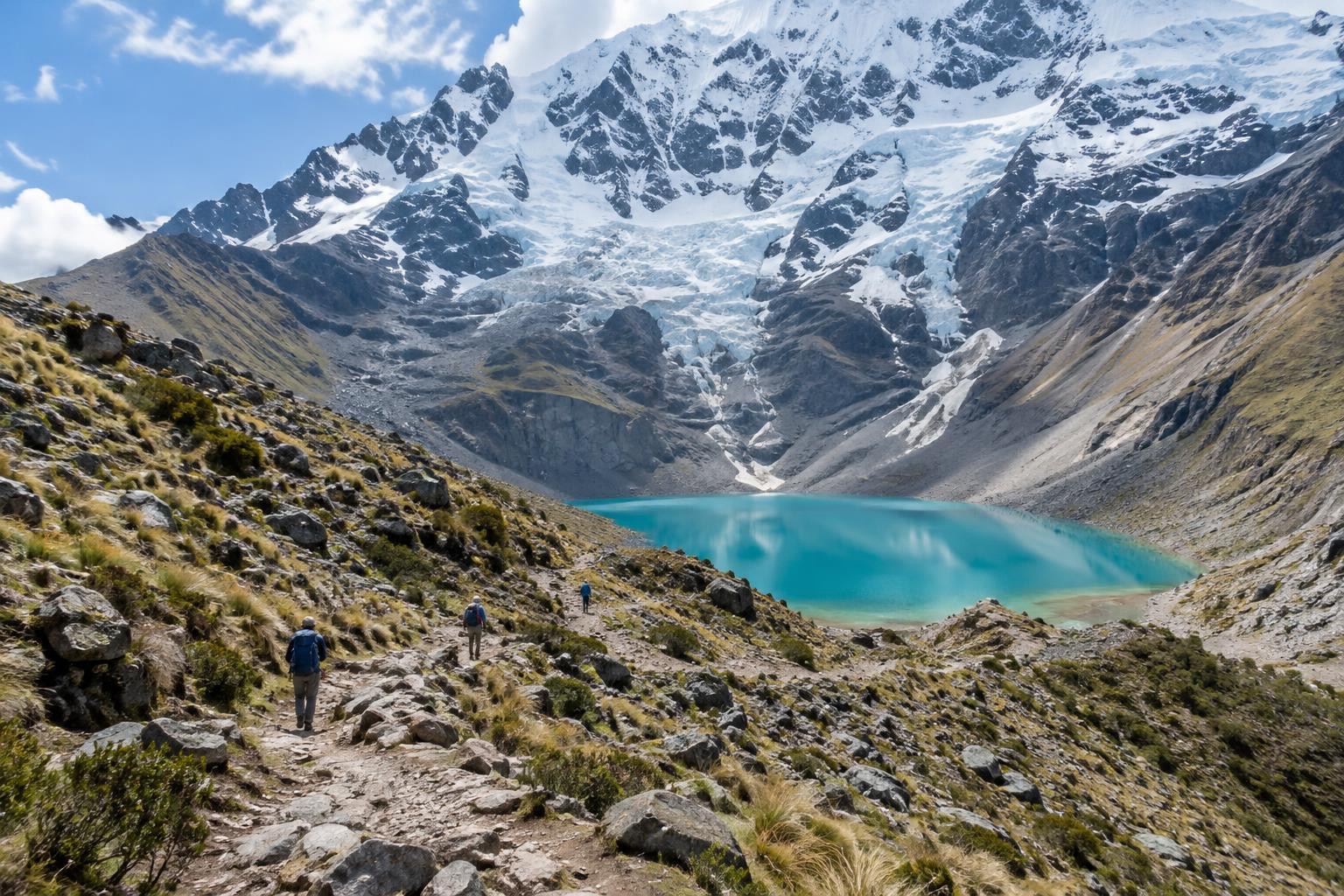
A short walk with a steep finish
Humantay Lake sits beneath high Andean peaks near Soraypampa and is commonly visited as a day walk or as part of a longer trekking route. Most visitors start walking at or near Soraypampa, but the precise starting point can differ by transport and itinerary. That is one reason route descriptions do not always agree on distance or climbing.
As a planning guide, expect a walk of a few kilometres each way and a climb of roughly 300 to 400 metres from the usual starting area to the lake. The lake is above 4,000 metres, and the trailhead is already high. Those figures are more useful as a warning about effort than as a promise about your route: a relatively modest ascent can feel sustained when the air is thin. Check the starting point and walking time for your own itinerary rather than relying on a single distance quoted online.
What the trail feels like underfoot
The route is generally a clear mountain path rather than a technical climb. It crosses open slopes before rising more sharply towards the lake. Expect uneven earth, stones and sections that can feel loose on the way down. After rain, patches may be muddy or slippery; in dry weather, dust and strong sun can make the same walk feel quite different. Conditions can change within a day, so look at the ground in front of you rather than assuming the whole path will be alike.
Sturdy walking shoes with reliable grip are a sensible choice. Trekking poles may help with balance, particularly on the descent, but leave room for other walkers on narrow stretches. Where horses use the route, give them space and follow the handler’s direction. Shortcuts across the slope may look tempting, yet staying on the established path is easier to navigate and helps limit wear on the hillside.
Pacing the climb at altitude
Begin more slowly than you think you need to. A pace that feels effortless on level ground may be too quick here, especially if you have only recently arrived at higher elevations. Aim for steps you can maintain without repeatedly rushing and stopping. On steeper stretches, shorten your stride and take brief standing breaks where you will not block the trail. If you are walking with others, agree that nobody needs to match the fastest person.
Allow generous time rather than treating an advertised hiking duration as a target. Stops for breath, changing layers and looking at the landscape are part of the outing. Drink water regularly and carry a snack, but avoid overloading your bag: even small amounts of extra weight can become noticeable uphill. People respond to altitude differently, and fitness at home is not a reliable guide to how the climb will feel. If you feel unwell, do not push on simply to reach the lake; descend and seek appropriate help if symptoms are concerning.
Plan for the descent, too
Reaching the water is only the halfway point. The return follows the same general route, and tired legs can make loose stones more awkward than they felt on the ascent. Leave enough daylight and energy to descend without hurrying. Pause at the lake to enjoy the view, but keep an eye on changing cloud, wind and temperature. A warm layer, rain protection and sun protection are useful even if the morning begins pleasantly.
Before setting out, confirm where your return transport will meet you and whether there is a firm departure time. If your schedule allows little margin for a slow climb or unsettled weather, reconsider the plan rather than trying to make up time on the trail. The best pace is one that lets you return safely, not one that produces the quickest arrival at the shore.
Enjoying the lake with a light footprint
Humantay Lake is a striking place, but it is also a mountain environment shared by other walkers and the people who work along the route. Carry out your litter, keep to any posted access rules and avoid entering the water. Give others space to pass or take in the view without turning the shoreline into a race for a photograph.
A little patience improves the experience. Weather may obscure the peaks, and the climb may take longer than expected; neither makes the walk a failure. Arriving steadily, spending time observing the landscape and leaving it as you found it are better goals than reaching the lake by a particular minute.


