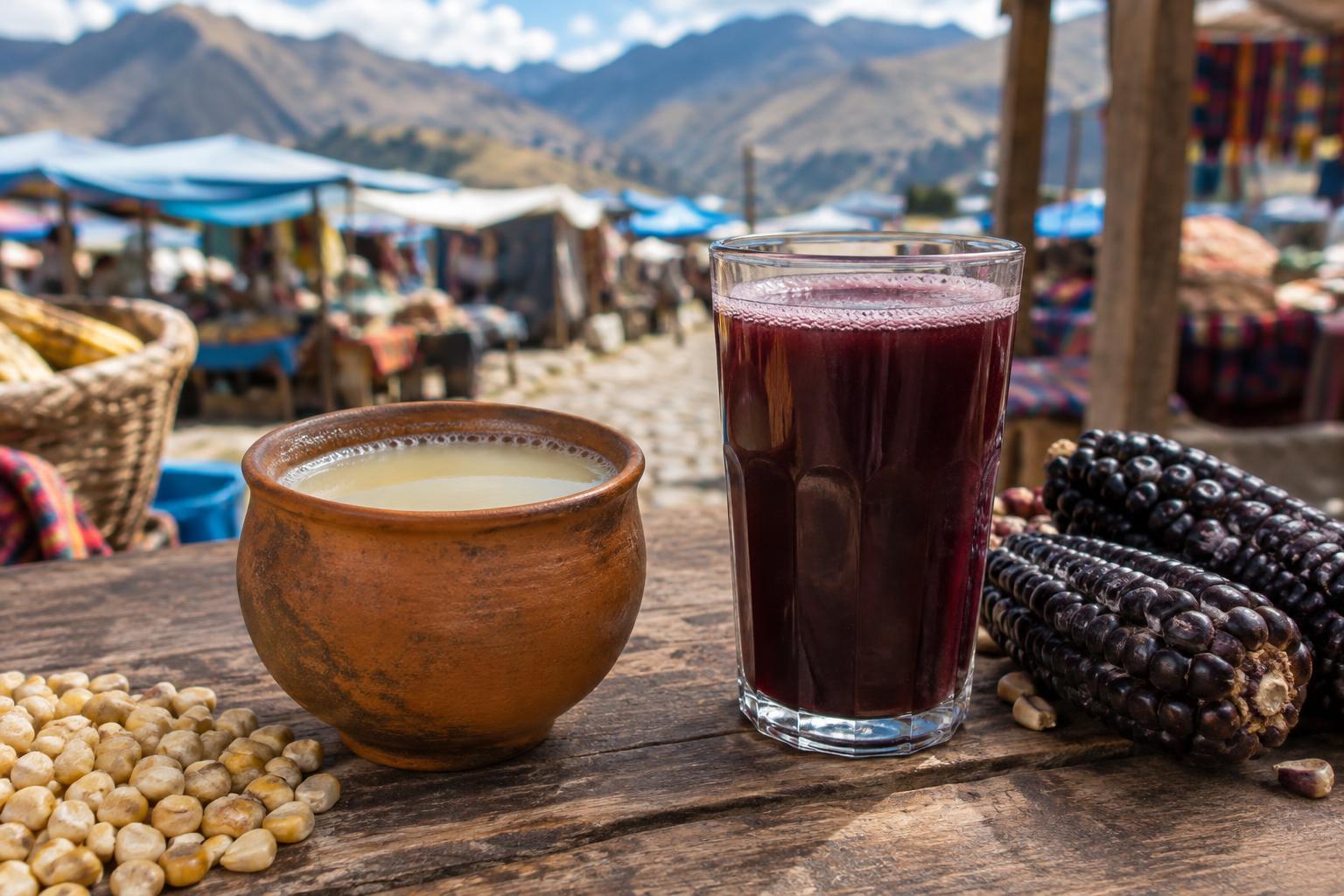
One name, many preparations
Across the Andes, “chicha” is a useful word to recognize but not a complete description of what is in your glass. Depending on where you are, it may refer to a fermented maize drink, a sweet purple-corn refreshment or a preparation made with another ingredient. Recipes also vary between households and vendors. Rather than treating one version as the authentic one, start by asking what the person serving it means by chicha.
The distinction matters if you avoid alcohol, have a food allergy or simply want to know what to expect. A menu may give the drink a more specific name, while a market stall may offer only a handwritten sign. Either way, a short conversation is more reliable than guessing from the colour, container or setting.
Fermented maize chicha
Chicha de jora, associated especially with Peru, is made from maize that has been sprouted before brewing. It is fermented and contains alcohol, although its strength and flavour can vary. It may taste tart rather than sweet, and it is not necessarily served chilled. Elsewhere in the Andean region, you may encounter other fermented maize drinks called simply chicha. The shared name does not mean they follow an identical recipe or have the same alcohol content.
For some people, chicha is more than a drink ordered alongside food; it can also be part of hospitality, gatherings or local celebrations. Customs differ, so watch how others are being served and ask if you are unsure. You can accept a small taste if one is offered, but you need not drink alcohol to be polite. A warm “gracias, pero no tomo alcohol” is a straightforward way to decline.
Purple-corn chicha and other versions
In Peru, chicha morada is usually a nonalcoholic drink made by cooking purple corn with ingredients that may include fruit and spices, then sweetening and cooling it. It is quite different from chicha de jora despite the similar name. If avoiding alcohol is important to you, still confirm what is being offered rather than relying on the word morada alone, particularly when ordering a house-made variation.
Maize is not the only possible base for a drink called chicha. Ingredients and names shift across regions, and some versions may contain fruit, grains or nuts. A familiar-looking drink can therefore present an unfamiliar ingredient. This is especially worth remembering with a nut allergy: ask directly about peanuts or other nuts, and do not assume that a vendor can guarantee the absence of cross-contact in a small kitchen.
Useful questions at a stall or table
Begin with “¿De qué está hecha?”—what is it made from? Follow with “¿Tiene alcohol?” if you do not want an alcoholic drink, and “¿Es fermentada?” if you want to understand how it was prepared. “¿Lleva maní?” asks whether it contains peanuts. If an ingredient is essential to avoid, explain that clearly before ordering rather than asking only after the glass arrives. A menu translation can help, but the person preparing the drink may know more about that particular batch.
If you are concerned about drinking water, ask how a cold drink was prepared and whether it contains ice: “¿Cómo la preparan?” and “¿Lleva hielo?” You can ask whether water was boiled or treated, though an answer may not resolve every concern about handling or storage. Use your own judgment about what to consume, especially when buying a freshly made drink in warm conditions. Bottled or packaged options may be easier to assess when you cannot get the information you need.
Drink with curiosity and respect
Take a moment to notice the setting before photographing a preparation or serving area. Ask permission, especially when people are working or sharing a meal. If a drink is offered in a communal setting, it is fine to ask how it is usually served rather than assuming there is one rule across the Andes. Local practices are specific to people and place, not a performance arranged for visitors.
The simplest approach is also the most rewarding: name the drink you are interested in, ask what went into it and listen to the answer. You may discover a version quite unlike one you tried in another town. That difference is not a mistake; it is a reminder that “chicha” opens a conversation rather than ending it.


