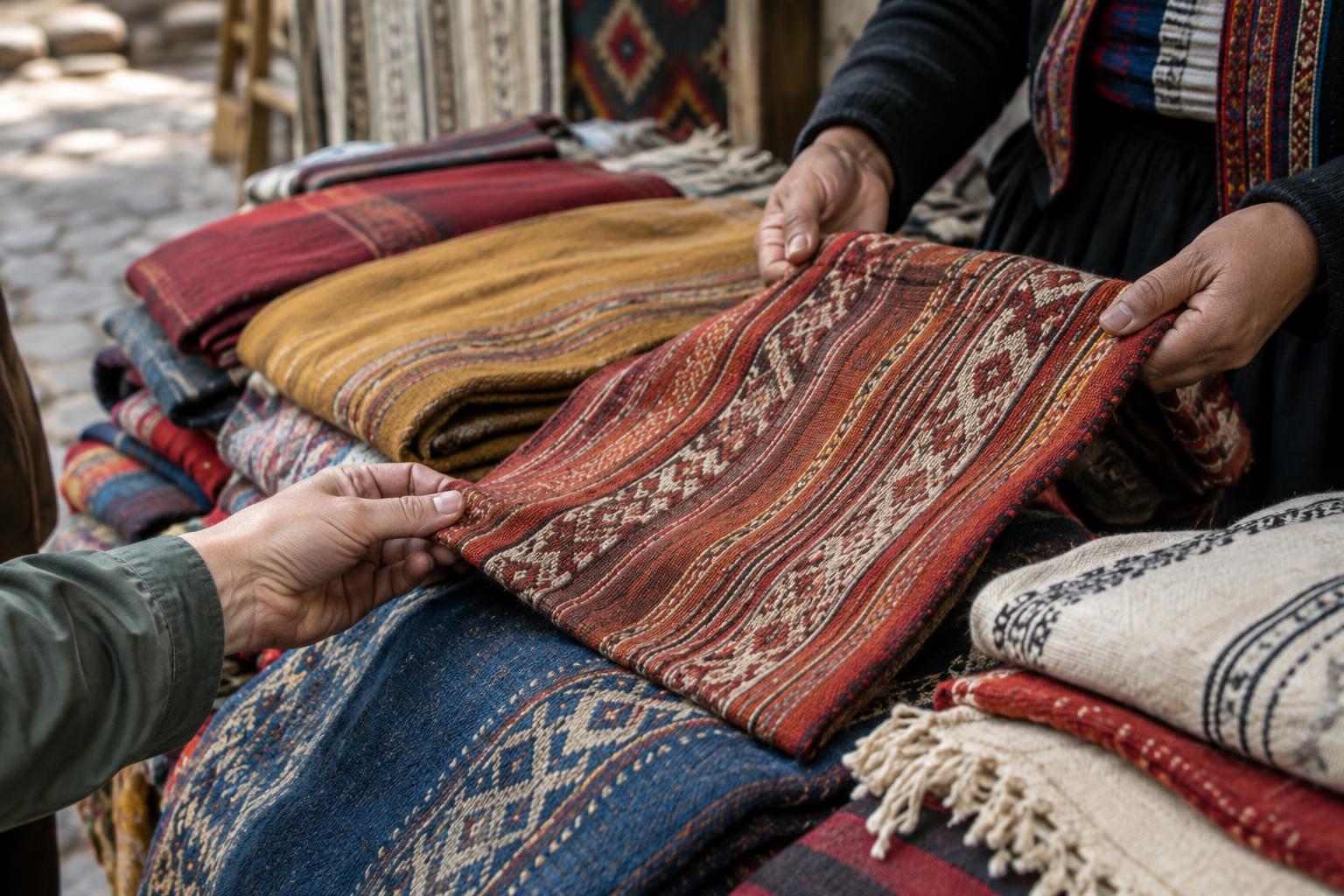
Start with the item in front of you
Textiles are part of everyday life and a popular travel purchase across the Andes. A market stall might offer woven cloth, knitted hats, bags and scarves at different prices. It can be tempting to sort them into two groups—“authentic handmade” and everything else—but production is often more complicated. An item may combine a commercially spun yarn with hand knitting, or handwoven fabric with a machine-sewn lining. Neither detail can reliably be determined from its appearance alone.
Approach a purchase as a conversation rather than a test. Begin by asking what an item is made from and how it was made, then listen to the answer without expecting the seller to account for every stage. The person selling it may have made it, bought it from a maker, or sourced it through a workshop or wholesaler. Those are different relationships, and it is reasonable to ask about them without treating any one answer as a failure.
Ask about fibres without guessing by touch
Labels and sales descriptions may mention alpaca, sheep’s wool, cotton or synthetic fibres, sometimes in blends. Softness, weight and warmth are not dependable ways for a visitor to identify a fibre: yarn construction and finishing also affect how a textile feels. If the material matters to you, ask, “What fibre is this?” and, for a blend, “Do you know what it is mixed with?” A seller may not know exact percentages, especially if the yarn was purchased without detailed labelling.
If you need to avoid a fibre for comfort or care reasons, say so plainly and favour an item with clear information. You can also ask whether a piece can be gently washed or whether it is best kept dry. When an answer is uncertain, treat it as uncertain rather than turning it into a promise about composition. Choosing a different item may be better than asking for a guarantee the seller cannot give.
Separate the stages of making
“Handmade” can refer to several stages: spinning yarn, dyeing it, weaving or knitting the fabric, and sewing or finishing the item. Asking “Which parts were done by hand?” is usually more informative than asking only “Is it handmade?” You might follow up with “Was this woven on a loom or knitted?” or “Was the yarn spun by hand or bought ready-made?” Ask one question at a time, particularly when a market is busy.
Machine-made cloth and commercially produced yarn are not automatically signs of a poor purchase. They may help keep an item affordable, durable or available in larger quantities. Conversely, visible irregularities do not prove that something was made entirely by hand. Focus on what you value—perhaps a particular technique, a useful everyday object or a colour you will wear—and look for a description that helps you make an informed choice.
Keep the conversation respectful
If you share a language with the seller, simple, specific questions work well. In Spanish, you could ask “¿De qué material es?” (“What material is it?”) or “¿Quién lo hizo?” (“Who made it?”). Spanish will not be everyone’s preferred language in the Andes, and you should not expect a detailed production history in any language. Be patient with pauses, translation and answers that are shorter than you hoped for.
If the seller mentions a maker, community or technique, avoid treating that information as a performance owed to you. Ask permission before photographing people or close-up work, especially if you are not buying. It is fine to browse, but a long interview can take time away from customers. When you want to learn more, buying an item or arranging a visit through a clearly described workshop may offer a better setting for an extended conversation.
Decide on value beyond a single label
Price can reflect materials, labour, design, transport and the way an item reaches the stall, but you cannot calculate all of that by looking at it. Compare pieces that serve a similar purpose, ask the price before committing and decide what fits your budget. If bargaining is customary where you are shopping, keep it courteous; if a price is fixed, respect that. Paying more does not, by itself, tell you how much reaches a maker.
Before buying, check the dimensions, seams and finish, and consider whether you can care for and use the textile at home. If its origin or method matters to you, remember the seller’s explanation accurately rather than later describing it as “entirely handmade” or from a particular place without confirmation. The most thoughtful purchase is not necessarily the one with the most romantic story. It is one you understand well enough to choose, pay for and use with appreciation.


