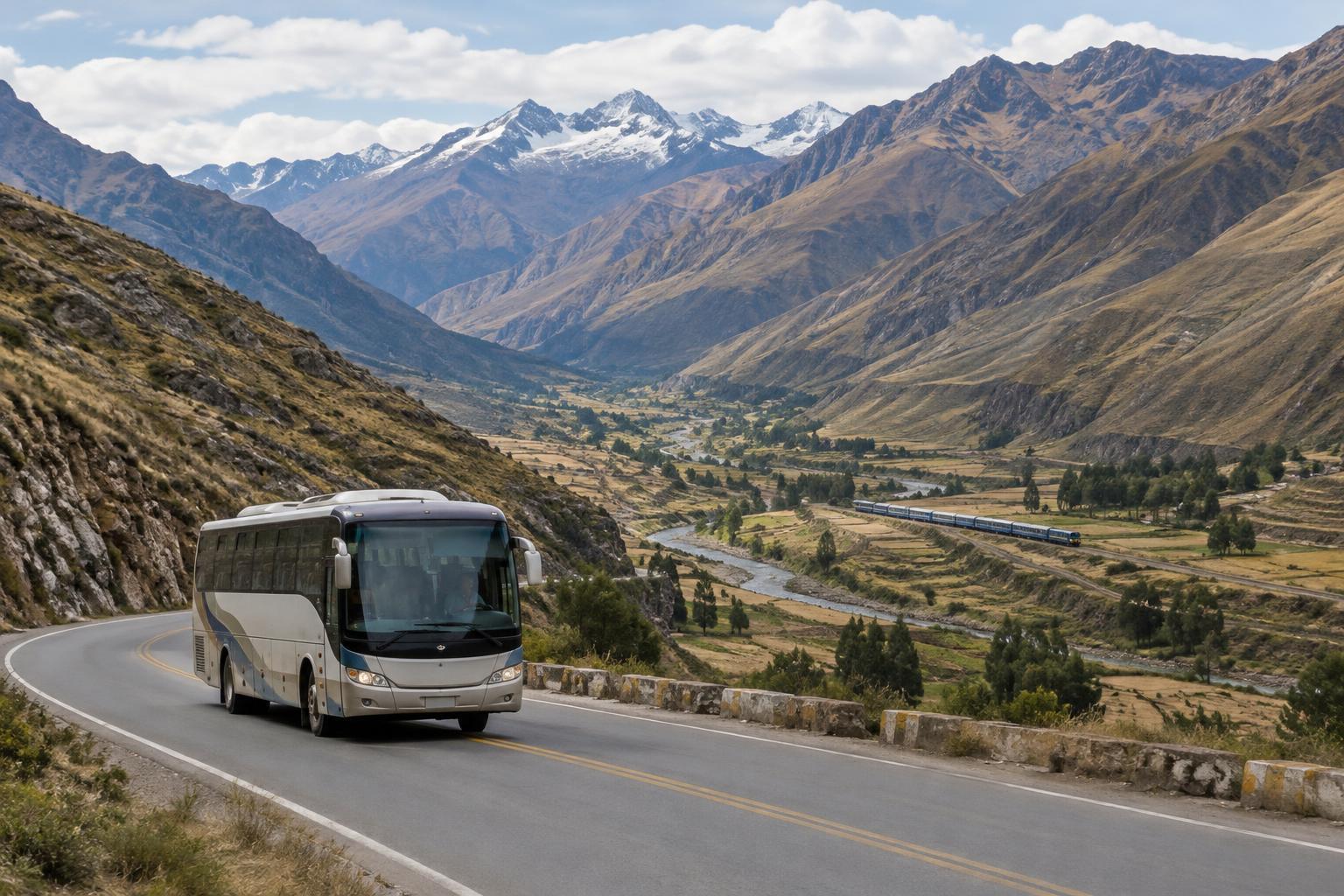
Compare the whole journey, not just the time in the air
On a map, a flight between two Andean destinations may seem like the obvious choice. Yet its advertised duration leaves out travel to and from airports, check-in, security and waiting for baggage. A bus may take longer on paper but depart closer to where you are staying and arrive nearer your next stop. Before booking, compare the time from accommodation to accommodation, including transfers at both ends.
Lower-impact travel is also more complicated than choosing the vehicle with the lowest emissions in general. A well-used coach or train will often be a worthwhile alternative to a short flight, but the comparison depends on the route, occupancy, energy source and extra transfers. The most useful question is whether an existing ground connection can serve your itinerary comfortably, rather than whether every journey must be made overland.
When a bus is a practical replacement
Buses connect many Andean towns and cities that have limited or no passenger rail service. They are especially useful when your next destination lies along a main road and you can travel directly. A daytime departure lets you see the terrain, take breaks where the service allows and arrive with enough energy to find your accommodation. An overnight service may save a day of sightseeing, but only if you are likely to rest well on board.
Mountain distances deserve caution. Winding roads, changes in elevation, weather and roadworks can make a journey feel longer than its distance suggests. Build some flexibility into days with onward connections, and avoid scheduling a demanding walk immediately after a long ride. If you are heading to a much higher elevation, a bus journey does not by itself guarantee time to adjust; plan your first days with that change in mind.
Check the details of the service, not just the fare. Departure and arrival points, luggage rules, planned stops and the expected arrival time can affect whether a route suits you. Choose a reputable, established operator where possible, keep essentials with you and make a plan for reaching your accommodation if you arrive after dark. If a road journey feels unworkable because of its length or timing, taking a flight can be a reasonable decision.
Where trains fit—and where they do not
Rail travel can be a memorable way to cross a landscape, but passenger trains do not form a continuous network across the Andes. Some services are designed chiefly for visitors, while others operate only on particular corridors. A rail line visible on a map is not a promise of a useful passenger connection. Confirm that a service runs between the places you need, on the days you need, before shaping an itinerary around it.
A train makes most sense when its route matches your plans without requiring long road detours at either end. Compare the complete trip with the equivalent bus and flight options, including transfers, luggage arrangements and arrival times. If a train is mainly a scenic excursion, enjoy it for that purpose rather than treating it automatically as a replacement for intercity transport.
Plan fewer, better-connected stops
The simplest way to reduce reliance on short flights may be to change the shape of the trip. Instead of returning to one city between distant stops, look for a route that moves steadily in one direction. Staying an extra night in a place along a bus corridor can turn an exhausting transfer into two manageable journeys and leave more time to experience the destination.
This approach also supports a less hurried visit. You can allow space for a local meal, a walk or an unplanned rest day without treating every town as a connection to the next. That does not mean adding stops solely to justify ground travel: extra transfers consume time and resources too. Choose places you genuinely want to visit and check whether they fit together naturally.
Make a choice you can sustain
Before settling on a route, ask four questions: Is there a direct ground service? How much longer is the complete journey? Will its arrival time and comfort work for everyone travelling? What happens if a connection is delayed? The answers may point to a bus for one leg, a train for another and a flight for a particularly difficult crossing.
Responsible travel is not a test of endurance. Taking ground transport where it works, allowing realistic time between destinations and treating fellow passengers and host communities with consideration are practical steps. A route you can travel safely and without constant haste is more useful than an ambitious overland plan you cannot comfortably follow.


